Showing posts with label San Diego. Show all posts

Friday, September 13, 2024

Brief Review: The Holy Book of the Beard (1996) by Duff Brenna


Although it’s set significantly in the Clairemont Mesa area, reading The Holy Book of the Beard I came to feel that it was the closest representation I’d seen in fiction of the culture of the East County San Diego that people in San Diego have often told me about. Published in 1996, the book feels like it could equally be describing the 70s and the 80s and forward. It’s a culture that may be changed by now, but don’t ask me because I wouldn’t know.

It’s a very white culture, one that’s an odd and in many ways unique combination of post-60s-revolution hippie looseness with the reality that these southern Californians are only a few years away from their escape from small U.S. towns in the midwest and south. The book is a reminder that Beat generation freedom-at-all-costs was often a white cultural phenomenon only, one that wasn’t necessarily leftist politically, since an “I’m doing it it my way” attitude doesn’t contain in it a whole lot of concern for others.

But the remnants of Beat Generation behaviors in these characters isn’t that of East Coast intellectual Ginsberg or West Coast adventurers Snyder and Kerouac (the west coast portion of Kerouac). This book portrays something that’s more Bukowski-style beat behavior, men with shitty jobs and behavior problems that start with drunkenness and go from there, and the women they take it out on. Here, freedom includes your right to be constantly bombed and punch out anyone, especially if she’s smaller than you. One of the characters is literary, and wow does he especially spout a lot of nonsense about how the world has mistreated him. For this one character, if few of the others, it seemed clear that Brenna’s intentions were satirical.

The women characters in the book are pretty tough-minded and tough-acting. They’d have to be to put up with the kind of behavior they have to put up with. The more sympathetic characters, usually women and at least one of the men, are the people who remain upset that the others behave as badly as they do. Everybody in the book is insular and full of themselves, but at least a few of them recognize that behaving that way is a problem.

The cultural environment of this book was for me its main fascination. But I could never quite tell whether Brenna realized that he was describing a deeply odd cultural context or whether he saw the depiction of sleazy half-tough drunkards with delusions of grandeur as a semi-hardboiled description of life as it is. The conclusion of the book, not entirely convincing, traipses into being southwestern Gothic. It made me think that the book was partly an Erskine Caldwell-like half-mocking, half-horrified exposé of some strange ignorant weirdos who think of themselves as wise. But I have to admit I’m not sure.

I had mixed feelings about the writing. The sentences and paragraphs have great energy and kept me involved, but every chapter is about twice or more as long as it needs to be. There’s a lot of writing in this novel that could have been cut back, and some characterizations are slammed home well past the point of tedium. Still, whenever I wasn’t bored, I was fascinated.

Ultimately I felt like the padding in the writing was in keeping, usually for worse rather than for better, with the self-indulgent rambling of the characters themselves. But the fact that they, and it, aren’t as interesting as they present themselves to be made me wonder. Maybe this undeniably talented writer absorbed a bit more than he ought to have of the heady combination of pot, sea air, fumes of gasoline and oil, and gallons of whiskey and Budwiser in which these sad, mostly unredeemable, and finally grotesque characters are drowning themselves and anyone unlucky enough to come in contact with them.


Sunday, October 9, 2011

&Now Literary Festival 2011: Tomorrowland Forever, at UC San Diego Oct 13-15


The complete program for the &Now Literary Festival in San Diego is now available here. An event like this doesn't happen often in San Diego, and is not to be missed.

Area college students should bring their I.D. and can attend the conference free of charge.

&Now Festival of New Writing: Tomorrowland Forever!

OCT. 13 – 15, 2011 @ UCSD

&NOW is a festival of fiction, poetry, and staged play readings; literary rituals, performance pieces (digital, sound, and otherwise), electronic and multimedia projects; and intergenre literary work of all kinds, including criti-fictional presentations and creatively critical papers.

Friday, February 12, 2010

Cooper Dillon Books (new poetry press in San Diego)


San Diego is one of the launching points for the press Cooper Dillon Books, currently being edited by Adam Deutsch (pictured above), who lives here in San Diego, and Colleen Ryor.

For more details, check out the Cooper Dillon website: http://cooperdillon.com/

There is also a blog which sends out announcements not just about their own books but about other presses in which they're taking an interest: http://presspresspress.blogspot.com/

Their first three titles are books by Gary L. McDowell, Jill Alexander Essbaum, and Nate Pritts.

New poetry presses are always great to find--and having one here in San Diego is especially rare. I hope you'll check out what they do and pick up a book or two.

Tuesday, November 3, 2009

Joseph Thomas and Mark Wallace reading at Agitprop this Saturday, November 7


The Agitprop Reading Series Presents:


Joseph Thomas and Mark Wallace


Saturday, November 7, 7 p.m.


A libertine of unimpeachable taste, Joseph T. Thomas, Jr. is an assistant professor of English at San Diego State University’s National Center for the Study of Children’s Literature. He is the author of two books, Poetry’s Playground: The Culture of Contemporary American Children’s Poetry (Wayne State UP, 2007) and Strong Measures (Make Now Press, 2007). Poetry’s Playground was named a 2009 honor book by the Children’s Literature Association.


Mark Wallace is the author of more than fifteen books and chapbooks of poetry, fiction, and essays. Temporary Worker Rides A Subway won the 2002 Gertrude Stein Poetry Award and was published by Green Integer Books. His critical articles and reviews have appeared in numerous publications, and he has co-edited two essay collections, Telling It Slant: Avant Garde Poetics of the 1990s, and A Poetics of Criticism. Most recently he has published a short story collection, Walking Dreams (2007), and a book of poems, Felonies of Illusion (2008). Forthcoming in early 2011 is his second novel, The Quarry and The Lot. He teaches at California State University San Marcos.


Reading Location:
AGITPROP Gallery
2837 University Avenue in North Park
(Entrance on Utah St., behind Glenn's Market)
San Diego, CA 92104
For more information, call 619.384.7989

The Agitprop Reading Series is currently hosted by James Meetze, but this event will feature special guest host Steve Willard.

Tuesday, March 10, 2009

Regional Literature (San Diego and elsewhere)


I’m continuing to look for a good work of literature, novel or other, about San Diego and the surrounding area, preferably a book I could teach that would give students a chance to consider the history and social dynamics of the place where they live. The San Diego area has not been the subject of much literature. There are a few recent novels about it that I’m aware of, but all of them are ultimately too imperfect for my needs.

Although I took classes years ago as an undergraduate that covered some regional literature (then often referred to as “local color”) such as Sarah Orne Jewett’s Country of the Pointed Firs, it has been a long time since I’ve heard much discussion of regional literature. It’s not a subject talked about much on the east coast. But there seems more need for it here in North County San Diego, where students often have a limited sense of their own cultural history. San Diego as a city and surrounding region was very much created by military and real estate interests and the connections of those to an often virulently right wing government. Those social forces have significantly shaped what this area has to offer and (more importantly maybe) what it doesn’t.

Here are some brief takes of the few San Diego novels I’ve read. I’m not sure how many more there are. If you know of other good, readable, recent regional novels about San Diego, other areas of California, or anywhere at all in fact, I’d love to hear your suggestions.


Oakley Hall, Love and War in California

The first two thirds of this book are the best novel about San Diego and its history that I’ve read. Set in the days leading up to WW II, this coming-of-age tale traces the social and political tensions in the San Diego of that era, centering on the narrator’s left wing sympathies as he grows up and his conflicts with others regarding love, sex, family, work, class, the military, and politics.

Unfortunately the last third of the book consists of two other much less successful sections. One briefly summarizes the narrator’s WW II experiences and another covers the rest of his life in a few short chapters. Both sections are rushed, awkward, and unengaging. I’ve rarely read a book that I enjoyed so much that fell apart so completely.

One demerit about the first part of the book. Much of the action centers on the narrator’s work for a left wing newspaper in San Diego in the 1930s and early 40s, and the conflict between that newspaper and other citizens and politicians. Those sections are some of the most important in the book. But when I heard Oakley Hall read from the novel only a few months before his death at age 87, he pointed out that actually there wasn’t a single left wing newspaper produced in San Diego during that time period (that’s right: none), although there was some labor organizing and resistance. On the one hand, fair enough: the book is fiction. On the other hand, as fiction, the book rather severely distorts the facts about the role of leftist struggle in the area prior to WW II. For my purposes that makes it much less useful.


Kem Nunn, Tijuana Straits

Different context, similar problem. The first half of this action thriller does a fantastic job describing the border lands between Mexico and the U.S. just south of San Diego and the political and sociological conditions of life there, with its poverty, crime and environmental degradation. The book traces brutality, indifference, and racism in a strange world that few people outside that specific local region know about. Powerful and eye-opening.

Once the criminals emerge more clearly, however, and go on their relentless search to kill the protagonists, the book’s action becomes increasingly ridiculous. A scene of our hero riding on a literal great wave of personal triumph and transcendence near the end of the book is jaw-droppingly bad. I spent most of the second half of this book laughing at the action, and I hurried to the end out of a sense of duty and a desire to see just how ridiculous things would get. The answer: even more ridiculous than I thought.


Jim Miller, Drift

I really wanted to like this novel. Miller is one of the co-authors along with Mike Davis and Kelly Mayhew of the most important book that I’m aware of about San Diego, the non-fiction social history Under the Perfect Sun: The San Diego Tourists Never See.

Drift is a good example of why polemics don’t always make convincing fiction. The actions of almost all the characters are designed to prove Miller’s points about the political corruption and social failures of contemporary San Diego. In fact some of this novel seems to borrow almost verbatim the history of rebellion and labor activism in San Diego that Miller wrote about in his section of Under the Perfect Sun, since the main character (like Miller himself) is an expert on that history.

The many sections with their many characters do have some vivid moments that create a picture of the kinds of lives people live in the San Diego and Tijuana areas. And the characters are at least sometimes well-rounded and subtle. But the main, longer running thread within the intertwined stories seems guided by such a heavy polemical hand that the tragic and disastrous elements of the book ring entirely false. As a writer, it’s difficult to create a convincing story for your characters if you’re determined to ruin their lives because you want to prove what’s wrong with San Diego. The result is no more convincing than those moralistic TV afternoon specials in which teenagers who drink alcohol at minute ten have to die at minute fifty.

Saturday, February 7, 2009

Reading in San Diego Saturday February 7

If you live in the San Diego area and are interested in poetry and fiction, come on out for tonight's reading featuring Vanessa Place and Teresa Carmody.

Details here.

Sunday, March 16, 2008

Big Ilya Makes It Big


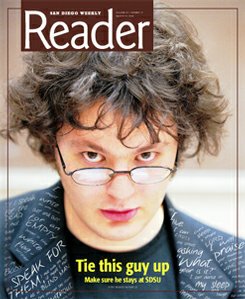
Or at least he’s made it to the front cover and main story of the San Diego Weekly Reader, with a caption reading “Tie This Guy Up: Make Sure He Stays at SDSU.” I’ve linked to the story here, and I hope you’ll read it.

For those of you who don’t know the San Diego Reader (which I’m assuming is most of you), it’s the main alternative weekly paper of the city, equivalent to the City Paper in Washington, DC and other similar versions elsewhere. The Reader is hardly as good as the City Paper, which is faint praise, I know, but there it is. They don’t even run Savage Love, for one, although a recent occasional series, Dumped, allows people to write in their stories about just how badly they let their romantic partners treat them before being left behind entirely. It’s a voyeuristic treat for those like me who enjoy that “how bad can it get” sort of thing.

The City Paper sometimes runs articles on local writers. They once did one on me, and on Buck Downs, and recently on Rod Smith. But they were small articles (and perhaps, uh, reveal a bit of gender bias?). This on the other hand is a cover story, and the picture, as you can see, is a big picture, with Ilya’s eyes looking down over his glasses skeptically and intensely at us all. This is some serious Local Press Cool Points.

Some of my friends in DC probably remember Big Ilya from when he lived there and was taking classes at Georgetown University. He became Big Ilya not simply because he was big (about six foot three) but because we also met another Russian emigré poet about the same time, Little Ilya, who was much smaller. In order to avoid people asking “Which Ilya?” dividing them into Big and Little made sense. Little Ilya has not so far made it as big, although I continue to wish him success for the future.

Being in theory the political center of the U.S. (although much of its power has long since been farmed out to various multinational corporations, in case you didn’t know), DC has a large international population. In fact there’s something of a history of Russian poets and Russian emigré poets in DC, although I myself don’t know it in detail. I remember, probably some time in 1996 or 97, my friend Joe Ross arranging to give a reading with a Russian emigré poet at the series I ran at the Ruthless Grip Art Project. I have pictures of the event, but I only met her that one evening and never saw or heard of her again, and I can’t remember her name. So Joe, if you’re reading this, can you fill me in? But in any case our audience that night featured a very sizeable Russian component, and the event was enjoyed by all. My impression is that the Russian presence in DC poetry has remained somewhat low profile but is also consistent. Recently my former colleague at George Washington University, Daniel Gutstein, was working with a young Russian-American poet, Olga Tsyganova, who has now gone to graduate school at Georgetown.

I’m hardly on expert on modern and contemporary Russian poetry or on Russian poetry in translation. For the most part I like the Russian poets that you might expect me to, given that I’m one of those people who still thinks the word avant garde means something worthwhile. Mandelstam, Akhmatova, Mayakovsky. Of living Russian poets I think Arkadii Dragomoschenko is really great, although I’ve heard it said that some Russian poets believe his work is too Americanized. There was a book called Blue Vitriol by Alexei Parshchikov published by Avec back in 1994 that I thought was very enjoyable. Much of the rest is a mishmash to me. Other Russian poetry I’ve read in translation can seem more than a little lugubrious, which is indeed just the word I want: long, image laden lines in a grim monotone. I don’t know enough to know whether that’s a function of what Russian poetry is like, or what it sounds like when translated into English, or whether it’s just my own lack of information. I’d love to be further informed, so let me know what you know.

In any case, on those occasions when I talked to him, usually when sitting in on a poetry seminar at Georgetown, where I taught a class now and then, Ilya seemed like a nice guy, and I wish him well. He published his first book, Dancing in Odessa, when he was 28, and it won something called The Dorset Prize. Now at 31 he’s an assistant professor at SDSU, so he and I are in the same business and just down the road from each other too. For his theories on poetry I’ll leave you to the article itself, although his basic theory, as quoted in the article, is “All young men’s poetry begins with a broken heart.” I suppose on some level I wouldn’t disagree, at least not entirely, although I imagine some of us might get, at times, a little tired of young men and their broken hearts.

Thursday, February 28, 2008

A New Reading Series in a Gallery in San Diego: Who Would Have Thought?


Without meaning this as a criticism, because there’s no reason anyone should have thought differently, I’ve been interested to note how many people assume that the city of San Diego must have at least something of a poetry scene. And certainly it does. But what’s there and what isn’t might be surprising.

Just in case anybody’s counting, the city of San Diego is currently the eighth largest city in the U.S. The massive size of its city limits somewhat exaggerates its population, but not entirely: San Diego County registers as the 17th largest Metropolitan Statistical Area in the country.

At this time, most of the literary series in the San Diego area happen at colleges: UCSD and San Diego State both have fairly large literary series, USD and Cal State San Marcos and a few small private colleges feature a reading now and then. Downtown there’s San Diego City College, which runs a lot of readings and music aevents and does good activist work in the heart of the city, to the extent that the city has a heart in the way that other cities do, which it only sort of does.

Also downtown there’s the Too Much Information GLBT reading series, which emphasizes important social issues and welcomes performative and experimental approaches. There are also a few small local scenes, spoken word to some extent but not only, one or two downtown, one in Oceanside/Escondido/North County, and perhaps one or two others that I barely know about. In La Jolla, D.G. Wills Books and Warwick Books host a number of events each year featuring first-rate writers of poetry, fiction, and non-fiction. UCSD has participated with the San Diego Museum of Art in featuring a few readings at the museum in Balboa Park. Local libraries feature an occasional reading too, and there’s even a mystery book store that brings in lots of mystery and crime writers, mainly for book signings. I haven’t lived in the area for even three years yet, so I could be missing something, but those are the series that I know about.

So that’s not nothing, that’s quite a bit. But is it quite a bit for the 8th largest city in the United States? It might seem, from that perspective, a little thin.

Like Los Angeles, San Diego County is large. There are many interesting writers here, but they often live far apart from each other. Getting to and from events is time consuming and, given the traffic, often not easy. Unlike Los Angeles though, arts culture is not the main business of San Diego. Still, there’s more going on here than there might be. But there’s also less than there might be.

What there certainly is not is any community-based scene centered on experimental/avant garde/post-avant/New American poetics (whatever you want to call it). Nothing like Beyond Baroque or The Smell in L.A., the Artifact series et al in San Francisco, Spare Room in Portland, Subtext in Seattle. You know the kind of thing I mean. While TMI, for instance, welcomes innovative literary approaches, that’s not automatically the center of their concerns.

But now one such series is starting this Saturday at Agitprop Gallery in North Park. I wish it well, and look forward to participating. It’s being co-hosted by James Meetze, who has organized a few area readings in the past, and Sandra and Ben Doller. If you live in the San Diego area, come on out. If not, I hope you’ll wish them well in gaining a toehold.

Here are the details:


NEW Triple Threat Reading Series--sponsored by 3 San Diego Small Presses: 1913 Press (ed. Sandra Doller), Kuhl House Press (ed. Ben Doller), Tougher Disguises Press (ed. James Meetze) announces its inaugural event...


Come one, come all to the first reading in North Park's new and explosive series. We begin with Noah Eli Gordon & Joshua Marie Wilkinson who are reading in support of their fresh new collaborative book Figures for a Darkroom Voice.


Agitprop Gallery in North Park
2837 University Ave. San Diego, California 92104
(entrance to the gallery is actually on Utah)
7:00pm Saturday, March 1st.


Noah Eli Gordon's first book, The Frequencies, was published by San Diego's own Tougher Disguises Press in 2003. Since then, he has had five other books appear, including Novel Pictorial Noise, which was selected by John Ashbery for the National Poetry Series, and published last year by Harper Perennial. Last year also saw the release of Figures for a Darkroom Voice, a book
written in collaboration with Joshua Marie Wilkinson. He writes a column on chapbooks for Rain Taxi: Review of Books, and his reviews and essays have appeared in numerous journals, including The Review of Contemporary Fiction, Publishers Weekly, Boston Review, and Denver Quarterly. He teaches creative writing at the University of Colorado in Denver. See him reading with Joshua Marie Wilkinson here: http://youtube.com/watch?v=aSENrRf0pNw


Joshua Marie Wilkinson is the author of Suspension of a Secret in Abandoned Rooms (Pinball, 2005), Lug Your Careless Body out of the Careful Dusk (U of Iowa, 2006), and The Book of Whispering in the Projection Booth (forthcoming from Tupelo Press). He holds a PhD from University of Denver and lives in Chicago where he teaches at Loyola University. His first film, Made a Machine by Describing the Landscape, a documentary about the band Califone, is due out next year. He curates Rabbit Light Movies, a website devoted to short poem-films, and recently co-edited an anthology of conversations between younger poets and their elders, which is forthcoming from the University of Iowa Press. See him reading with Noah Eli Gordon here:
http://youtube.com/watch?v=aSENrRf0pNw