Showing posts with label folk horror. Show all posts

Tuesday, August 12, 2025

The Beast and Other Tales by Jóusè d'Arbaud


Someone on Facebook read The Beast and Other Tales by Jóusè d'Arbaud and enjoyed it and that encouraged me to read it, and thanks to you if that was you (I don’t remember). The first story and longest tale is the main attraction of the book. Still, the three other surprising and moving stories also deal with the inexplicable, the vastness of the universe (even on the most local scale), loneliness, and guilt. They are all set in a place I’d more or less otherwise never heard of: the Camargue Delta, a region where the Rhöne River meets the Mediterranean, a flat delta of shrubs and grass and water and mud south and east of the town of Arles, France.

Written in 1926, “The Beast of Vacarés” is a horror story of sorts, reminiscent to me of Mary Shelley’s Frankenstein (obviously) and Arthur Machen’s Hill of Dreams (more subtly). It’s a tale with a moody sweep of landscape that features an profoundly odd encounter between an isolated bull herder and something (someone?) that, well, I won’t say any more about. The back cover of the book does say more, and what it says feels both right and wrong in its implications of what the encounter involves. The tale is not going to provide easy answers, or a lot of comfort. Powerful, strange, unforgettable.

If you’re looking for a story to take you to a place far out of the world you recognize, there’s one right here.

Tuesday, July 19, 2022

The Changeling by Joy Williams


Talk about an ambivalent reaction to a book. There were so many things about Joy Williams’ The Changeling that I loved and quite a few that I didn’t like at all.

Positives:
Fabulous imagery, often very disjointed and yet logical in its odd associations, a psychological weirdness that reminded me of Shirley Jackson. A still quite contemporary-seeming American surrealism that was often deeply convincing.
Propulsive, unforgettable sentences with a relentless drive.
An interest in psychological perverseness and the fringes of human complexity.
A vivid collapsing of the boundaries between the human and the animal.

Negatives:
A lack of narrative energy and focus, despite the intense energy of the sentences. Events in the book meander more than develop, and at times the momentum of the narrative comes nearly to a complete stop while the powerful sentences just kept going. There are significant stretches of the book that feel like the story is going nowhere.
Unconvincing portrayals of the real, especially when it comes to the nature of events. The “real world” in the book is at times at odds with the “dream world” and at times seems to blend with it. While that’s interesting when I put it that way, in practice the passages that seemed to be taking place in reality were often not convincing and relied boringly on coincidence and the unlikely. “Maybe it’s all a dream” is both unconvincing in terms of the narrative and also a boring cliché.

I also had mixed feelings about the stream of consciousness passages, which had a sort of “look what I can do” showiness that felt imitative and not essential.

Add it all up, I guess, and there’s a mix of less convincing story and narrative elements with fascinating writing and world view.

Sometimes I read the reviews on Amazon of ordinary people who write responses to an author or book, and I found all sorts of people saying things not all that different from what I’m saying about not only this book but others of hers as well: brilliant writing and strange thinking but unfocused stories that people lose interest in.

So my conclusion: at best, brilliant. At other times, an unconvincing pile of words that’s not headed anywhere. And no, I’m not saying something here that’s anti-experimental fiction. Experimental fiction still usually has narrative drive, and this book isn’t especially experimental anyway. The introduction to the 30th Anniversary Edition comes from Rick Moody; Williams’ work seems most connected to the context of later 20th century American realism even while the realism of this book is very thin.

Anyway, if you’re a fan, help me understand what you like about Joy Williams’ work.


Sunday, May 22, 2022

Shudder Folk Horror Movies Thumbnail Reviews Batch Two


I’m not sure how much longer the Folk Horror collection on Shudder will be available, since Shudder rotates its titles fairly frequently. In any case I’ve enjoyed watching all these movies, even the ones I didn’t like much. It was a fun project. The term “folk horror” feels pretty broad at times as a descriptor for all these films, but nothing I watched seem to fall outside the concept, which ultimately makes it pretty effective as a term for thinking about the subject matter and themes of these films.

The Wicker Man, British, 1973 (5 stars): Still often called the best British horror movie ever made, and I’ve not seen anything that makes me disagree. I have a DVD box set of this movie. Nearly every moment is beautiful; nearly every moment is eerie and disquieting, and the pervasive discomfort just keeps building. As a viewer, you always know something’s wrong, but the film is so surprising and original that you never know what it is. By the way, the hugely popular 2019 film Midsommar borrows tons from this movie and I haven’t seen anybody else note that. And I can say this and viewers still won’t know what to expect from this movie.

Il Demonio, Italian, 1963 (4 ½ stars): Surprisingly and effectively, this movie splits the difference between an Italian neorealist film and a horror movie. Set in a convincingly disturbing rural environment, the movie depends on Daliah Lavi’s outrageous and compelling portrayal of a out-of-control character who often turns out to be less disturbing than the more ordinary people around her. The movie’s not scary really, but it sure is disconcerting. Also, there’s a scene in it that’s the basis of an infamous scene in the director’s cut of The Exorcist. The scene was probably cut from The Exorcist for good reason, but the original in Il Demonio is riveting.

Kill List, British, 2011 (4 stars): This movie is even more brutal than its brutal trailer would lead you to believe. But it’s also a much better movie than the brutality might lead anyone to suspect. The situation is off-kilter and disturbing, the characterizations are effective, and even if one has a general sense of what way the mysterious elements of this film are going, I myself didn’t really see the ultimate turns coming. There’s more than a little Tarantino influence here, but this movie is really doing its own thing. I’m not kidding about the brutality though, so consider yourself warned.

The Blood on Satan’s Claw, British, 1971 (3 ½ stars): The term “folk horror” was originally used by reviewer Rod Cooper in describing this movie. It’s quite enjoyable although much of the story is ridiculous and the psychology of it paper thin. Good atmospherics and tone carry the day so that the action doesn’t become too ludicrous to bear. The atmospherics of this movie are quite foundational in terms of many horror movies that follow it, including The Wicker Man, so it’s an essential folk horror watch despite moments that might make you laugh derisively.

La Llorona, Guatemalan, 2020 (3 stars): There are some things to like about this movie and a lot not to like so much. Director Jayro Bustamante borrows heavily from Guillermo Del Toro, but as much as I like the idea of setting a horror movie in a rich historical and political context, the movie takes the worst part of Del Toro (and the reason I’m not a fan of Pan’s Labyrinth): a heavy-handed political moralizing that precludes much surprise. At every moment, this movie tells us exactly who is bad and for what reason and in what degree and then proceeds to sledgehammer its agenda into place. There’s a good sense of mood, good acting, and some memorable and at times chilling visuals, and those things help lift it above its dull and obvious moral lecture.

Dark in August, American, 1976 (3 stars): The first hour of this movie is quite good, a four star effort that establishes intriguing characters and a striking rural setting. J.J. Barry is an original presence as the main character. But then there’s the rest of the movie.

Clear Cut, Canadian, 1971 (2 ½ stars): Graham Greene is such a compellingly watchable actor that he almost pulls off the two-dimensional character he plays He also overwhelms the mediocre performances by the other actors. The plot, about a land struggle between white Canadians and indigenous people, has all of the expected features but not much more. I like it when horror gets political, but that like anything else needs to be done well. The film is supposedly controversial because of the stand it takes that sometimes violence might just be the best response to oppression, but I didn’t care enough about the white characters to be concerned at how badly they were beating treated. Don’t more conventional slashers also suggest that it’s tremendous fun to see stupid arrogant assholes get sliced and diced and that the world is a better place when they’re gone?

Tilbury, Icelandic, 1987 (2 ½ stars): The flat acting and lack of convincing action were on some level an important part of this odd little film, which tries to combine the presence of an ancient horror with a historical drama of World War II Iceland during a period of occupation by supposedly friendly British and American troops. The disjointedness made the action difficult to care about, so this movie survives on its weirdness mostly, and it was often weirder than I was expecting, with some scenes that are surrealist not in a loose sense but truly.

Roh, Malaysian, 2019 (2 stars): Sigh. I was rooting for this movie when I started watching it. But the story was verging on absent, and the mythology was general and vapid: bad things happen to bad people, and even the possible twist that everyone might be bad couldn’t save the slow scenes, the barely comprehensible narrative turns, and the lack of strong atmosphere. A lot of the story revolves around a mother failing her children, or supposedly failing her children, but I’ll be darned if I could ever figure out what it was she was supposed to have done. Apparently she became a bad mother right when her husband died, or was being accused of being one from that moment, not that the story ever resolved or even really approached an answer to what had created the problem.

Sunday, April 3, 2022

The Folk Horror Collection on Shudder


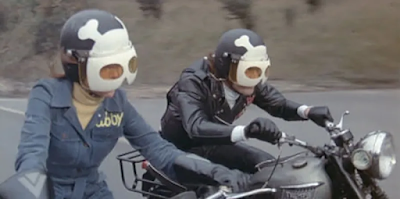
Photograph from Psychomania


I’ve been enjoying the Folk Horror collection of movies on Shudder with its fun mix of national and international pictures. Here are my thumbnail reviews on a five-star scale of the ones I’ve seen so far (will maybe add to this list and post it again at a later time)in the order of my preferences.

Texas Chainsaw Massacre, American, 1973 (5 stars)
Still one of a small handful of the best and most terrifying horror movies ever made.

Lake Mungo, Australian, 2008 (4 stars).
Easily the best of the movies I’d never seen before. Tense, creepy, surprising, and subtle, and because of the subtlety, the moments that are not subtle are very effective. Some underdeveloped or missing psychological elements bring this one down just a little.

Psychomania (also known as The Death Wheelers), British, 1985 (4 stars). There are few horrors movies this fun and this ridiculous and this unique. It’s not great except for the fact that it’s so great. “The greatest British zombie biker ever made”: for once, the hype is true.

Black Sunday, Italian, 1960 (4 stars). Mario Bava’s first horror film is legendary for a reason. I can’t say that this movie is great, exactly, but it’s very very satisfying horror, a mix of British and Italian elements and starring Barbara Steele, who’s just as good at this sort of movie as everybody says.

Black Sabbath, Italian, 1963 (3 ½ stars). This three-part horror anthology follow-up meant to capitalize on Black Sunday isn’t as great as that one, but it has Boris Karloff in it and the action is a lot of fun if not particularly scary. The effects are ludicrous but only make the movie more of a pleasure.

Wake Wood, Irish and English, 2009 (4 stars). This movie has a lot of great moments and others that aren’t as great as they could have been. Still, it’s the best of the recent horror movies from Ireland that I’ve seen.

Impetigore, Indonesian, 2019 (3 ½ stars). The first 30 to 45 minutes of this movie: wow. As frightening as any recent horror movie I’ve seen. After that, some of the key characters start becoming really dumb, which means that when the horror effects come on full bore it mostly seems like the idiots are getting what they deserve.

Alison’s Birthday, Australian, 1981 (3 ½ stars). The acting and effects are very B movie but they also work in the favor of this surprisingly enjoyable movie. Good claustrophobic tension. The characterizations are no more than expected but still fun. The action is often ridiculous but somehow still both fun and tense.

Rawhead Rex, British, 1986 (3 ½ stars). Sure, the special effects are exactly as terrible as everyone says, but for me at least that didn’t take away from the enjoyment I felt at this movie. I may be biased because it’s based on a Clive Barker short story and because its premise is basically that of classic M.R. James ghost stories: an ancient, pagan evil is lurking in a graveyard. It’s not slow, and there are some great surprises, some of them very unpleasant.

Pyewacket, Canadian 2017 (3 stars). The characterizations aren’t subtle yet this portrayal of a distressed teenager stuck in her relationship with her nasty mom does have some good scenes and good tension. As many reviews say, the movie is as much character study as horror, and while both elements show some promise, the movie doesn’t do as much with them as it might.

A Dark Song, English, 2016 (3 stars). This movie has an effectively tense pace at the start, with interesting characterizations and surprising scenes, but like so many horror movies it doesn’t always know what to do with its premise or the complexities it wishes to set in motion but can’t.

The Hallow, Irish and English, 2015 (3 stars). Essentially, this movie is the same story as Wake Wood with some small differences. Strong atmospherics at the start, and surprisingly interesting dialogue. At a certain point the characters get stuck in a permanent state of non-development and the well done but standard visuals take over with very little surprise.

Lake of the Dead, Norwegian, 1958 (3 stars). A historical curiosity, this black and white, low budget movie has some engaging characters and dialogue (some of it tense) and benefits from its rural setting. The mystery being uncovered is worth it, although the characters are much more frightened than viewers will be.

Children of the Corn, American, 1984 (3 stars) No, I didn’t bother to watch it again. Not the best Stephen King-based movie by any means, and not the worst either. This movie is not as bad as the people who think it’s bad like to think, but it’s also not as good as people think when they try to argue for it as underrated.

Lokis, Polish, 1970 (3 stars). A bit long and rambling, this movie has good atmosphere and tension and some surprises. As much a character study as horror, this movie’s main draw for me is that it’s based on a 1869 French gothic novel by Prosper Mérimée. The pace of the movie is slow so prepare to settle in.

Jug Face, American, 2016 (3 stars). Another of the movies in this collection whose opening parts are the best ones, this movie has some intriguing performances by women but, women-centered or not, it doesn’t do all that much beyond the expected with its dangerous backcountry hick premise.

Eyes of Fire, British, 1983 (2 ½ stars). This one has some moments of genuine strangeness and effective gore. Decent characterizations. The effects are goofy but sometimes enjoyable. Ultimately it settles for flatness and dreamy vagueness instead of really developing its core conflicts and concepts.

Viy, Russian, 1967 (2 ½ stars). Based on a novella by Nikolai Gogol, the main reason to watch this movie is that it’s billed as the first horror movie ever made in Russia. It’s a horror comedy that’s not scary and barely funny except when it’s most trying not to be. The visual effects as the movie goes on are really quite enjoyably strange, but this movie is mostly of historical interest only. Sidepoint: Russians probably don’t need a horror film tradition because their own history gives them all the horror anyone could want.

Messiah of Evil, American, 1973 (2 ½ stars). This is a standard low budget American horror of its era. A few compelling moments, but none of it is ever any better than it looks like it’s going to be. B movie fans might find a lot to enjoy.
 
Dark Waters, filmed in Ukraine, 1993 (2 stars). Great scenery, and at moments some of the characters are truly weird, but mostly the story is boring and obvious and never frightening or much of anything else, although Louise Salter as the main character is fun to watch.