Friday, July 8, 2022

The Circular Staircase by Mary Roberts Rinehart (my Goodreads review)


This book is a fun, energetic, easy read, of no huge distinction until you realize that it was published in 1908, a dozen years before Agatha Christie’s first book. What that means is that the things it seems like it might have in common with Christie’s work (a big rural house, untrustworthy servants, most people as possible suspects, etc.) are not things that Rinehart, an American author, borrowed from Christie.

Otto Penzler’s introduction identifies Rinehart as the leader of a loose school of “Had I only known!” authors. While I don’t think I’ll be following that particular lead any further, it’s interesting to note that Rinehart’s curious overuse of this foreshadowing technique was seen by others as a good way to build suspense. If Rinehart is hardly the first American woman writer of detective fiction, she seems like a big player too in the history of the cozy mystery concept. Nothing in the book is ever really shocking, no matter how often the narrator, Rachel Innes, is shocked, and the book feels entirely light and easy-going.

Miss Innes, as she is usually called by others, is not the official detective, although she certainly does plenty of sleuthing. She’s someone who wants to maintain order and happiness among her family and the others she cares about and is determined to do so. She’s curious sometimes, and sometimes not, but she’s always protective. It’s interesting to think of her amateur detective status, and that of a few other amateur women detectives, as preceding the creation of Christie’s Miss Marple.

One serious caveat about these books: the class and race attitudes, although gentle in expression, are pretty appalling not only by contemporary standards but probably even by those of the progressive political era of American history in which the books appeared. Servants are invariably silly and superstitious, and if they’re black they’re especially superstitious even if they might otherwise be portrayed as thoughtful and sensitive. There’s only one line, late in the book, that’s aggressively offensive, but the light-hearted class and race humor doesn’t fare well now, and people who want old works of pop literature to offer present-day standards should consider themselves warned.

There’s nothing great about this book, and nothing about it is remotely convincing, but it moves along at a highly energetic pace for a book more than a hundred years old, and I enjoyed it. I think the book will mostly be of interest to people who want to know more about the history of detective fiction and the history of detective fiction by and about women particularly.

This review can be found also on my Goodreads page:


Monday, July 4, 2022

What Happened to the Confederate Press?


I’ve been looking for an adequate answer to this question for awhile and never found it before reading Harold Holzer’s Lincoln and the Power of the Press. What role did newspapers and government intervention into newspapers play in the role of the Confederacy? In contrast to the rambunctious, contentious Northern press, which produced viewpoints of all kinds, why was the Confederate press so limited and controlled?

Holzer’s book isn’t just about Lincoln and the press but about the development of newspapers in the United States from the 1830s through the end of the Civil War. Yes, Holzer looks at Lincoln’s deep involvement in the world of newspapers over the whole of his life and political career, but the book is more broadly about the connection between newspapers and politics in American life during the years leading up to the Civil War. Holzer shows not so much how changes in American newspapers affected the ways people saw the war, but how newspaper men actively intervened in and shaped and sometimes controlled Northern response, often including official response, to the war.

One of Holzer’s basic points is that far from creating comments that came from outside the world of U.S. politics, the U.S. newspaper industry was directly connected to the U.S. political industry, with many people going back and forth between roles at newspapers and official government roles as politicians. As his key opening example of this interconnection, Holzer gives details regarding the fact that in 1859, Abraham Lincoln purchased and subsequently ran a German-language newspaper operating out of his hometown of Springfield, Illinois, although very few people even then knew about it. Lincoln’s investment (financial as well as political) in the world of newspapers was one of his most key and successful political practices.

Holzer’s 566-page book devotes only five of its pages to the history of Confederate newspapers. What’s surprising is that those few pages are all that’s really needed to answer the question of what the Confederate press was and what became of it.

Why did the Confederate press not keep its citizens as widely informed as the Northern press? Why was there so little information, why was it so controlled, and why did the Confederate press play such a very small role in the life of people in the South, offering them poor information, late information, and often enough no information at all?

For context, it’s important to understand that during the Civil War, in the North there was in no simple sense freedom of the press, although there was equally no simple censorship. Instead there were newspapers presenting all perspectives, including pro-slavery and pro-southern ones, and including newspapers whose owners and editors were accused of being, and sometimes were, traitors secretly supporting Confederate armies. It was often forbidden to report on the specific movements of troops, reports which might reach Confederate armies. The question of what ideas might be forbidden, under a national government that officially supported freedom of the press, depended on who you asked.

Who might do the forbidding was also a key issue, and the answer was different in different cases. Censorship was sometimes enacted on specific newspapers, editors, or reporters by Union army generals and other military and political representatives stationed in the local environments of the press in question. It was just often enacted unofficially by citizens who would attack press buildings or the operatives of those presses, including reporters, when those presses or reporters were seen as pro-Confederacy. If censorship was never a broad and clear political policy in the North, it was never absent either.

Lincoln’s response to all of this was, as Holzer shows, yet another example of Lincoln’s political savvy.

Lincoln said very little publicly on the subject beyond supporting general concepts of freedom of the press and denying that one had the right to tacitly or explicitly be a traitor. In practice he often said nothing when local officials shut down or destroyed an anti-Union press, although he sometimes chastised generals for going too far (especially if they weren’t generals who had won important battles). He also helped some Democratic presses and journalists (that is, those that might be pro-slavery and anti-war but not traitorous) return to production, although only after stern warnings. So Lincoln never said a lot publicly in favor of censorship while being willing to see it happen, encouraging or discouraging it in some cases.

So what was the Confederate Press like during the Civil War and why does it get only four pages in Holzer’s extremely detailed book? The answer turns out to be both simple and startling.

During the Civil War, in the South, Holzer writes, “a once robust two-party political culture vanished” (457). There was increasingly over the years of the Civil War no Confederate press at all.

Holzer lists a couple of key reasons why the Confederate Press vanished. One of them is not a lack of readers. People living in and under the Confederacy were often desperate for news, and just as often they couldn’t get it.

The first reason Holzer gives for the vanishing of the Confederate press was “near-universal white conscription.” Nearly all white males roughly ages 16-65 were required to join the Confederate army and fight, which left very few white men able to run a press or be a reporter. How the men who were exceptions came to be exceptions is something that Holzer’s book doesn’t discuss.

Another key element is that what Southern presses did remain were shut down quickly by the Union Army whenever a city was successfully invaded. The Union knew very well the role that Southern newspapers had played, often through false and outrageous stories, in creating the war in the first place, and so the army shut them down and also helped pro-Union papers in the South get started. As early as 1862, there were pro-Union papers in parts of the Carolinas, Florida, Louisiana, Tennessee and Virginia.

Lastly, and this reason was the most surprising to me: as the Civil War went on, the Confederacy and its supporters increasingly had little or no paper. And so, obviously, they had nothing to create a newspaper on. As Holzer points out, “The South boasted only a fraction of the nation’s paper mills before the war began, and fewer still once Union forces began occupying significant portions of its territory” (458). Given this extreme shortage of paper, newspapers had to cut back publication and increasingly just ceased. In some cases, they continued for a while publishing small, often even one-page editions. During the siege of Vicksburg, an extreme case obviously, the one remaining newspaper in town published a few small editions on the backs of former bits of wallpaper from (I’m guessing here) buildings abandoned in Vicksburg when the citizens left their homes during the bombardment to live in caves.

A few Confederate newspapers, like the Charleston Courier, held on longer than others, and surprisingly a few new periodicals Confederate periodicals opened (temporarily), but editions were small both in terms of numbers of pages and sizes of print runs and they could reach no more than a few people. Obviously, such papers had only limited information to offer and presented only pro-Confederacy perspectives.

A few years ago, a friend of mine said when I was talking with him about differences in the news and newspaper cultures of the North and South that he had probably assumed, without thinking about it, that news in the North and the South operated on relatively similar principles. As it turns out, not only was what could and couldn’t be said very different (not to mention what was and wasn’t said), what was even more different was the material and social conditions under which newspapers could say anything at all.

In the North, wildly energetic press activity tried to present a huge range of perspectives, including those of not just pro-slavery and pro-war voices but of acting traitors to the Union cause. It ran up against equally loose and fractious censorship activity, sometimes military and government, sometimes unofficial groups of angry citizens, activity that for the most part Lincoln quietly supported or condemned from a distance.

In the South, the one-party Confederacy had, over time, fewer and fewer newspapers to publish its perspectives, fewer reporters to write them, and ultimately no paper on which those perspectives could be written.

I’ll conclude this essay with one final thought: in the days of the Internet, any individual or group no longer needs paper to produce large scale editions of their perspectives that can be distributed widely. A post-paper, Internet news future is one in which the mechanics of reaching people has profoundly changed. It’s a change that will affect the future of war, rebellion, and revolution in ways we are only now beginning to see.


Sunday, May 22, 2022

Shudder Folk Horror Movies Thumbnail Reviews Batch Two


I’m not sure how much longer the Folk Horror collection on Shudder will be available, since Shudder rotates its titles fairly frequently. In any case I’ve enjoyed watching all these movies, even the ones I didn’t like much. It was a fun project. The term “folk horror” feels pretty broad at times as a descriptor for all these films, but nothing I watched seem to fall outside the concept, which ultimately makes it pretty effective as a term for thinking about the subject matter and themes of these films.

The Wicker Man, British, 1973 (5 stars): Still often called the best British horror movie ever made, and I’ve not seen anything that makes me disagree. I have a DVD box set of this movie. Nearly every moment is beautiful; nearly every moment is eerie and disquieting, and the pervasive discomfort just keeps building. As a viewer, you always know something’s wrong, but the film is so surprising and original that you never know what it is. By the way, the hugely popular 2019 film Midsommar borrows tons from this movie and I haven’t seen anybody else note that. And I can say this and viewers still won’t know what to expect from this movie.

Il Demonio, Italian, 1963 (4 ½ stars): Surprisingly and effectively, this movie splits the difference between an Italian neorealist film and a horror movie. Set in a convincingly disturbing rural environment, the movie depends on Daliah Lavi’s outrageous and compelling portrayal of a out-of-control character who often turns out to be less disturbing than the more ordinary people around her. The movie’s not scary really, but it sure is disconcerting. Also, there’s a scene in it that’s the basis of an infamous scene in the director’s cut of The Exorcist. The scene was probably cut from The Exorcist for good reason, but the original in Il Demonio is riveting.

Kill List, British, 2011 (4 stars): This movie is even more brutal than its brutal trailer would lead you to believe. But it’s also a much better movie than the brutality might lead anyone to suspect. The situation is off-kilter and disturbing, the characterizations are effective, and even if one has a general sense of what way the mysterious elements of this film are going, I myself didn’t really see the ultimate turns coming. There’s more than a little Tarantino influence here, but this movie is really doing its own thing. I’m not kidding about the brutality though, so consider yourself warned.

The Blood on Satan’s Claw, British, 1971 (3 ½ stars): The term “folk horror” was originally used by reviewer Rod Cooper in describing this movie. It’s quite enjoyable although much of the story is ridiculous and the psychology of it paper thin. Good atmospherics and tone carry the day so that the action doesn’t become too ludicrous to bear. The atmospherics of this movie are quite foundational in terms of many horror movies that follow it, including The Wicker Man, so it’s an essential folk horror watch despite moments that might make you laugh derisively.

La Llorona, Guatemalan, 2020 (3 stars): There are some things to like about this movie and a lot not to like so much. Director Jayro Bustamante borrows heavily from Guillermo Del Toro, but as much as I like the idea of setting a horror movie in a rich historical and political context, the movie takes the worst part of Del Toro (and the reason I’m not a fan of Pan’s Labyrinth): a heavy-handed political moralizing that precludes much surprise. At every moment, this movie tells us exactly who is bad and for what reason and in what degree and then proceeds to sledgehammer its agenda into place. There’s a good sense of mood, good acting, and some memorable and at times chilling visuals, and those things help lift it above its dull and obvious moral lecture.

Dark in August, American, 1976 (3 stars): The first hour of this movie is quite good, a four star effort that establishes intriguing characters and a striking rural setting. J.J. Barry is an original presence as the main character. But then there’s the rest of the movie.

Clear Cut, Canadian, 1971 (2 ½ stars): Graham Greene is such a compellingly watchable actor that he almost pulls off the two-dimensional character he plays He also overwhelms the mediocre performances by the other actors. The plot, about a land struggle between white Canadians and indigenous people, has all of the expected features but not much more. I like it when horror gets political, but that like anything else needs to be done well. The film is supposedly controversial because of the stand it takes that sometimes violence might just be the best response to oppression, but I didn’t care enough about the white characters to be concerned at how badly they were beating treated. Don’t more conventional slashers also suggest that it’s tremendous fun to see stupid arrogant assholes get sliced and diced and that the world is a better place when they’re gone?

Tilbury, Icelandic, 1987 (2 ½ stars): The flat acting and lack of convincing action were on some level an important part of this odd little film, which tries to combine the presence of an ancient horror with a historical drama of World War II Iceland during a period of occupation by supposedly friendly British and American troops. The disjointedness made the action difficult to care about, so this movie survives on its weirdness mostly, and it was often weirder than I was expecting, with some scenes that are surrealist not in a loose sense but truly.

Roh, Malaysian, 2019 (2 stars): Sigh. I was rooting for this movie when I started watching it. But the story was verging on absent, and the mythology was general and vapid: bad things happen to bad people, and even the possible twist that everyone might be bad couldn’t save the slow scenes, the barely comprehensible narrative turns, and the lack of strong atmosphere. A lot of the story revolves around a mother failing her children, or supposedly failing her children, but I’ll be darned if I could ever figure out what it was she was supposed to have done. Apparently she became a bad mother right when her husband died, or was being accused of being one from that moment, not that the story ever resolved or even really approached an answer to what had created the problem.

Wednesday, May 11, 2022

The Last Time I Saw These Copies of Thomas Pynchon


These rank among the most life-changing books for me. Now that these copies are falling apart, I wanted to photo them and comment on them before the copies (not the books themselves) exit my life.

I first found out about Thomas Pynchon in a graduate class taught by William Spanos (RIP) on Postmodern Fiction at SUNY-Binghamton. We really did read Gravity’s Rainbow, over at least two weeks if I recall, although I don’t recall, not entirely. Other books we read in that class included Calvino’s On A Winter Night a Traveler, Kundera’s The Book of Laughter and Forgetting, and Borges’ Labyrinths. I loved most of the books in that class, but right now I don’t remember the others.

But Pynchon, wow. Gravity’s Rainbow sent me into another universe of possibility entirely. The politics, the open-ended quality, the nearly impossible combination of humor and seriousness, the huge geographical and historical worldview. Not long after, I published my first work of fiction on the graduate level (I had published some stories in undergraduate magazines). It was called “The Last Time I Saw Thomas Pynchon,” a series of vignettes in which I as narrator encountered Pynchon as character in a series of absurd, urban, postpunk environments (I was very much a postpunk at the time) and he told me things I needed to know.

I picked up and soon read V and The Crying of Lot 49 as well. At that time, Pynchon hadn’t published a new novel in more than 15 years, so this was the era when these three books, and the short story collection Slow Learner, were all the available Pynchon fiction there was, the later avalanche still unforeseen. He was sometimes referred to in print as a 60s satirist whose half-earned moment of fame was long gone.

Anyway, I’m wishing these near-pulp editions goodbye. They have long since pulped themselves. I suppose, human or book, sooner or later we all pulp ourselves, although some pulp gets under our skin a lot deeper than others. In fact it’s just as I write this that I remember one scene from my now lost story “The Last Time I Saw Thomas Pynchon”: he as character and me as narrator met at a garbage dump, where he told me that I could learn more about people’s lives by going through their garbage than by looking at the objects they kept in their houses.

To prove his point, here’s some garbage of mine.

Sunday, April 3, 2022

The Folk Horror Collection on Shudder


Photograph from Psychomania


I’ve been enjoying the Folk Horror collection of movies on Shudder with its fun mix of national and international pictures. Here are my thumbnail reviews on a five-star scale of the ones I’ve seen so far (will maybe add to this list and post it again at a later time)in the order of my preferences.

Texas Chainsaw Massacre, American, 1973 (5 stars)
Still one of a small handful of the best and most terrifying horror movies ever made.

Lake Mungo, Australian, 2008 (4 stars).
Easily the best of the movies I’d never seen before. Tense, creepy, surprising, and subtle, and because of the subtlety, the moments that are not subtle are very effective. Some underdeveloped or missing psychological elements bring this one down just a little.

Psychomania (also known as The Death Wheelers), British, 1985 (4 stars). There are few horrors movies this fun and this ridiculous and this unique. It’s not great except for the fact that it’s so great. “The greatest British zombie biker ever made”: for once, the hype is true.

Black Sunday, Italian, 1960 (4 stars). Mario Bava’s first horror film is legendary for a reason. I can’t say that this movie is great, exactly, but it’s very very satisfying horror, a mix of British and Italian elements and starring Barbara Steele, who’s just as good at this sort of movie as everybody says.

Black Sabbath, Italian, 1963 (3 ½ stars). This three-part horror anthology follow-up meant to capitalize on Black Sunday isn’t as great as that one, but it has Boris Karloff in it and the action is a lot of fun if not particularly scary. The effects are ludicrous but only make the movie more of a pleasure.

Wake Wood, Irish and English, 2009 (4 stars). This movie has a lot of great moments and others that aren’t as great as they could have been. Still, it’s the best of the recent horror movies from Ireland that I’ve seen.

Impetigore, Indonesian, 2019 (3 ½ stars). The first 30 to 45 minutes of this movie: wow. As frightening as any recent horror movie I’ve seen. After that, some of the key characters start becoming really dumb, which means that when the horror effects come on full bore it mostly seems like the idiots are getting what they deserve.

Alison’s Birthday, Australian, 1981 (3 ½ stars). The acting and effects are very B movie but they also work in the favor of this surprisingly enjoyable movie. Good claustrophobic tension. The characterizations are no more than expected but still fun. The action is often ridiculous but somehow still both fun and tense.

Rawhead Rex, British, 1986 (3 ½ stars). Sure, the special effects are exactly as terrible as everyone says, but for me at least that didn’t take away from the enjoyment I felt at this movie. I may be biased because it’s based on a Clive Barker short story and because its premise is basically that of classic M.R. James ghost stories: an ancient, pagan evil is lurking in a graveyard. It’s not slow, and there are some great surprises, some of them very unpleasant.

Pyewacket, Canadian 2017 (3 stars). The characterizations aren’t subtle yet this portrayal of a distressed teenager stuck in her relationship with her nasty mom does have some good scenes and good tension. As many reviews say, the movie is as much character study as horror, and while both elements show some promise, the movie doesn’t do as much with them as it might.

A Dark Song, English, 2016 (3 stars). This movie has an effectively tense pace at the start, with interesting characterizations and surprising scenes, but like so many horror movies it doesn’t always know what to do with its premise or the complexities it wishes to set in motion but can’t.

The Hallow, Irish and English, 2015 (3 stars). Essentially, this movie is the same story as Wake Wood with some small differences. Strong atmospherics at the start, and surprisingly interesting dialogue. At a certain point the characters get stuck in a permanent state of non-development and the well done but standard visuals take over with very little surprise.

Lake of the Dead, Norwegian, 1958 (3 stars). A historical curiosity, this black and white, low budget movie has some engaging characters and dialogue (some of it tense) and benefits from its rural setting. The mystery being uncovered is worth it, although the characters are much more frightened than viewers will be.

Children of the Corn, American, 1984 (3 stars) No, I didn’t bother to watch it again. Not the best Stephen King-based movie by any means, and not the worst either. This movie is not as bad as the people who think it’s bad like to think, but it’s also not as good as people think when they try to argue for it as underrated.

Lokis, Polish, 1970 (3 stars). A bit long and rambling, this movie has good atmosphere and tension and some surprises. As much a character study as horror, this movie’s main draw for me is that it’s based on a 1869 French gothic novel by Prosper Mérimée. The pace of the movie is slow so prepare to settle in.

Jug Face, American, 2016 (3 stars). Another of the movies in this collection whose opening parts are the best ones, this movie has some intriguing performances by women but, women-centered or not, it doesn’t do all that much beyond the expected with its dangerous backcountry hick premise.

Eyes of Fire, British, 1983 (2 ½ stars). This one has some moments of genuine strangeness and effective gore. Decent characterizations. The effects are goofy but sometimes enjoyable. Ultimately it settles for flatness and dreamy vagueness instead of really developing its core conflicts and concepts.

Viy, Russian, 1967 (2 ½ stars). Based on a novella by Nikolai Gogol, the main reason to watch this movie is that it’s billed as the first horror movie ever made in Russia. It’s a horror comedy that’s not scary and barely funny except when it’s most trying not to be. The visual effects as the movie goes on are really quite enjoyably strange, but this movie is mostly of historical interest only. Sidepoint: Russians probably don’t need a horror film tradition because their own history gives them all the horror anyone could want.

Messiah of Evil, American, 1973 (2 ½ stars). This is a standard low budget American horror of its era. A few compelling moments, but none of it is ever any better than it looks like it’s going to be. B movie fans might find a lot to enjoy.
 
Dark Waters, filmed in Ukraine, 1993 (2 stars). Great scenery, and at moments some of the characters are truly weird, but mostly the story is boring and obvious and never frightening or much of anything else, although Louise Salter as the main character is fun to watch.

Monday, March 21, 2022

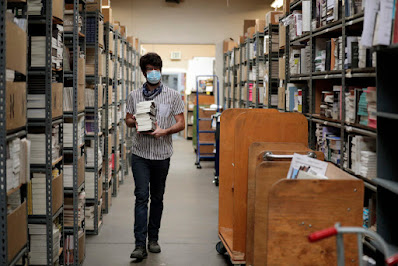
Publishing and Book Availability (Part two of a conversation that began on Facebook)


I wasn’t expecting quite so lively a discussion regarding my suggestion on Facebook that more small presses might try producing print-on-demand books, but since I got it, the responses made me realize I had more to say.

What everyone on that thread probably knows is that the publishing world continues to change, inevitably, and what was true 20-30 years ago has become something else now. Of course, it’s easier to know something than to understand the implications of knowing it.

When I was first aware of it, what was great about Small Press Distribution was that it was unlike nearly everything else: a great online bookstore of otherwise hard to find small press books. 20-30 years ago, it was already true that there weren’t many on-the-street bookstores where one could find a range of interesting small press literature. In Buffalo when I lived there I had Talking Leaves nearby, and when I lived in D.C. I had Bridge Street Books.

I relied less on SPD than other people might who lived in towns or cities where finding a range of books was difficult or impossible, and even then SPD had things hard for me to get elsewhere. SPD was an early online book goldmine. It served an alternative literary culture that was spreading out to more and more places and becoming less defined solely by people in the few major urban areas in the U.S. that had a thriving literary scene and lots of local readers of literature.

Having physically limited spaces, bookstores have never stocked everything. They’ve always had to choose what is relevant to give space to. An online distribution store like SPD still needs to have a warehouse and so has space and employee limitations as well. In any case, no one distributor can possibly distribute everything and so decisions have to be made about what to include and why.

What we see now is an age of the internet very different than 2002. There are more small presses, and smaller presses (“micropresses,” if you think providing micro labels will help) than ever. They have an internet presence and are capable of making well-produced books using online production methods (sorry, don’t know what else to call them) much more sophisticated than in the past. Some people buy directly from these small presses through their websites, while these presses often still want and need other options for distribution.

We also live in an environment of overwhelmingly large online corporate entities that provide more distribution than an organization like SPD can and can cause serious harm to the very concept of an independent press or bookstore even while providing useful distribution services. Obviously, these corporate behemoths have made the survival of great independent local bookstores more difficult, even in the urban environments that used to support them, and they threaten the independence of an organization like SPD as well.

What I think is often difficult for everybody is learning how to handle an evolving situation (which of course is what all situations are, says a voice in my head). Newer small presses need new outlets, older small presses also may need new outlets but also feel new pressures threatening the degree of independence they fought hard for in the past and are still fighting for now. And readers want to be able to get books.

Evolving publication realities combine with an ever-increasing diffusion of literary cultures which are oddly enough both more localized and more homogenized at the same time. People anywhere are now more easily in touch with people anywhere else, and an urban literary scene defining itself in relative isolation so that “schools of poetry” develop is becoming more and more a thing of the past. We don’t even have to imagine what would happen now if if there was a group of surrealists trying to decide stridently who’s in and who’s out, because we can see it all around: they would be criticized instantly and precisely for their exclusivity on the grounds of race / class / gender / culture and various other aspects of their lack of equal access.

I don’t know any more than anyone else about how this publishing environment will continue to evolve. New presses and publishing options will keep arising and some will stick around longer than others. Massive corporate conglomerates will keep trying to own all that can be owned and to turn every existing possibility into something ownable. There will continue to be writers and presses and bookstores and even distributors resisting corporatizing and homogenizing forces. Some things will work better and longer than others, and that includes the vicious ones. Books in whatever form will continue to be produced. The specifics are beyond me, obviously. “You can’t step in the same river twice” wasn’t created as an advertising slogan.

I’m posting this on Facebook though I know it’s long, and putting it on my blog too so it won’t disappear (vain hope, huh?) quite so quickly. I remember when live literary conversations had to happen in person or over the phone and when the most interesting (to me) published conversations were happening in publications that existed only in a few hundred copies.

Then conversations like that moved to email and then to listservs and online group discussions and then to blogs where individuals had more control and then to social media and probably through some available formats I never even noticed. With increased opportunity comes increased ephemerality. At the same time, more books covering those conversations continued and continue to be published, calling into further question the idea that it’s even possible to be fully informed about a conversation.

By the moment anybody stops talking, the situation they were talking about has already changed.

Wednesday, March 9, 2022

I have poems in the March 2022 issue of the Brooklyn Rail and will be reading a few on March 11, 2022


I’m pleased to have some poems in the March 2022 of The Brooklyn Rail. Thanks to Anselm Berrigan and the other editors and workers who do such a great job with that publication. Here’s the link.

https://brooklynrail.org/2022/03/poetry/three-322b?fbclid=IwAR1k1rRvxrlxufAIZcajv7sPGc4cpd8tPvzepFGtZWcC6ilCJ6PI9Ts8Ol4


Also, I’m reading a few minutes of poetry this Friday March 11 around 11:10 or 11:15 a.m. Pacific Time for The Brooklyn Rail at the conclusion of an discussion roundtable on the art of Ad Reinhardt. The event is free although you do need to sign up beforehand. The discussion begins at 10 a.m. Pacific Time. Scroll to the bottom of the event page to sign up.


https://brooklynrail.org/events/2022/03/11/color-out-of-darkness-ad-reinhardt-curated-by-james-turrell/?fbclid=IwAR3SUUyoPi9K9ys9clL3MihPy3-WJRNy_bnM1kaBqjTV73U9dL_c7CjJHMA